Bound and Enslaved Persons Listed On This Page
- Jo
- Cudjo
- London
- Boson
- Lidia
- Hannah
- Frank
- Sarah
- Nanny
- William Finley (white indentured servant)
- Philip
Introduction
Politician, judge and wealthy landowner Jeremiah Langhorne of Middletown, Bucks County, Pennsylvania lived 1673-1742. He emigrated with his family from England and settled in Pennsylvania. Like his father, Thomas Langhorne, Jeremiah served in Pennsylvania's colonial assembly and was a close friend of William Penn. Langhorne was elected speaker of the Assembly in 1721, serving in that role for two terms, and held various other positions in Pennsylvania colonial government. He was a judge, and rose to the postion of Chief Justice of the Colonial Pennsylvania Supreme Court, making him one of the most powerful and well known men of this time.
Jeremiah Langhorne lived comfortably at his Bucks County estate Langhorne Park until his death in 1742. Unmarried, he bequeathed the estate and most of his possessions to his nephews and nieces, surviving family members and friends. A substantial portion of his written last will and testament makes detailed provisions for the people he enslaved on his estate, estimated at between thirty and forty persons at his death. All but one were immediately manumitted if adults, and younger slaves upon reaching age twenty-four. While manumitting slaves upon death was not necessarily rare at this time, Langhorne added provisions in his will to ensure they had housing and enough resources for their care and well-being.
The Will of Jeremiah Langhorne, May 1742 (Excerpts)
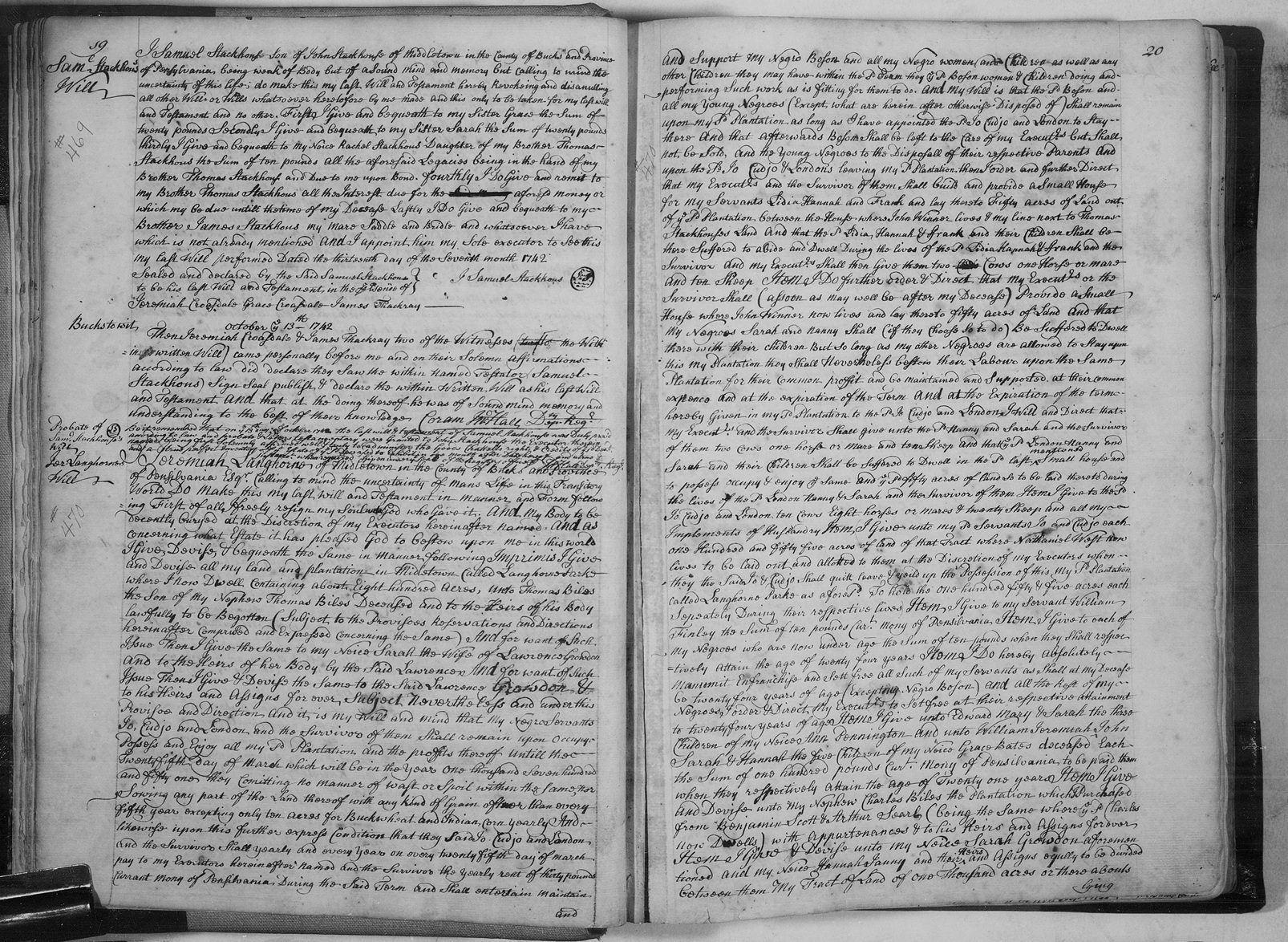
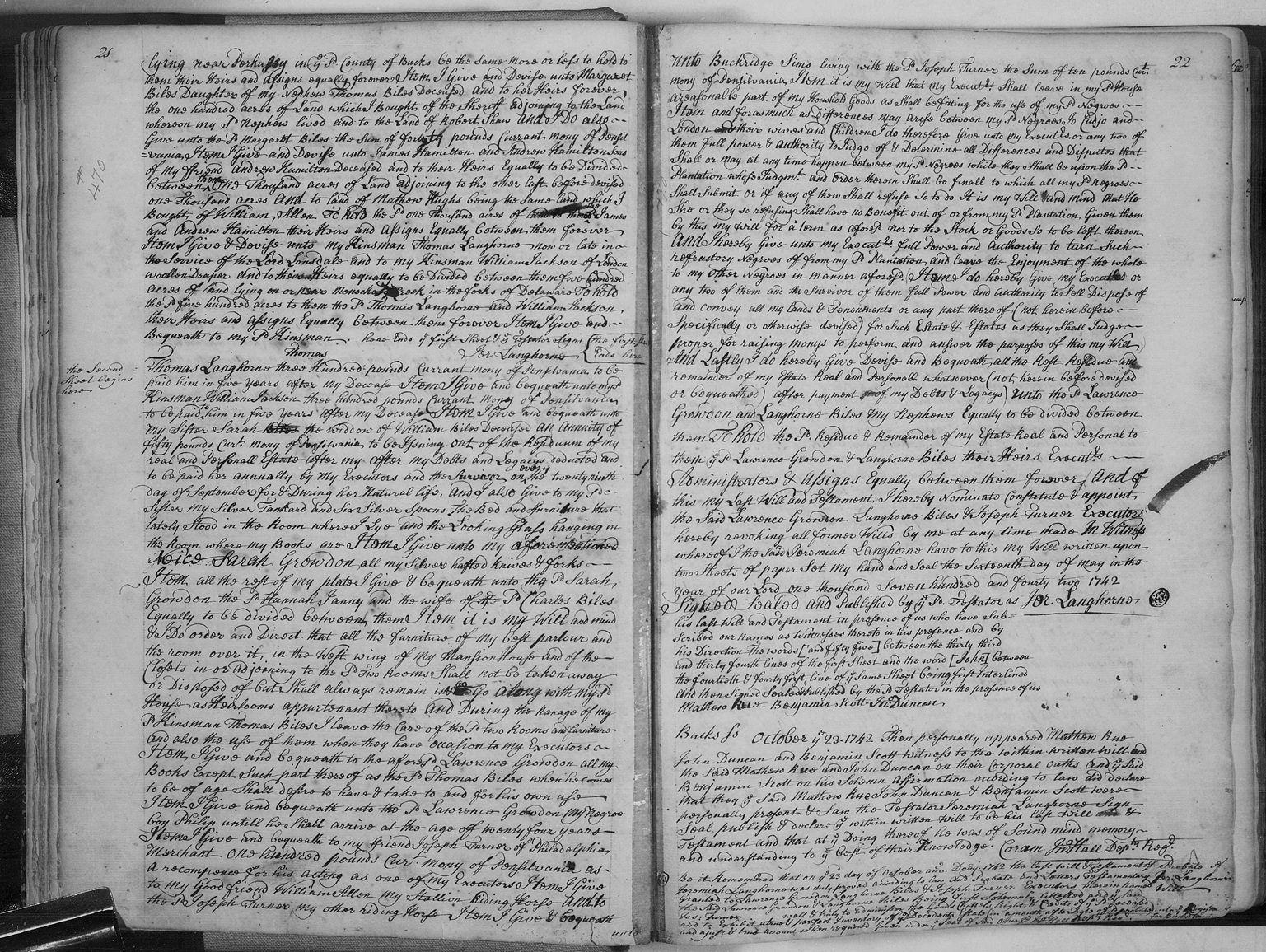
The following is a transcript of selected portions of the last will and testament of Jeremiah Langhorne. Line breaks have been added for easier reading and to isolate select passages and provisions. This transcript is taken from the handwritten copy of the will from the Bucks County Recorder of Wills, Will
Books, Book 2, pages 19, 20, 21 and 22, microfilm, Mercer Museum Library, Doylestown, Pennsylvania.
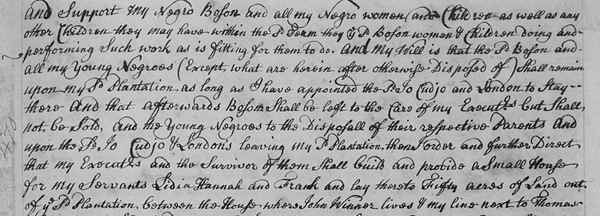
[Transcript, Sheet 1]
I Jeremiah Langhorne of Midletown in the County of Bucks and Province of Pensilvania Esqr. Calling to mind the uncertainty of Mans Life in the Transitory World Do Make this my last Will and Testament in Mannor and Form folllowing
First of all I freely resign my Soul with God who Gave it, And my Body to be decently buryed at the Discretion of my Executors hereinafter named. And as concerning what Estate it has pleased God to bestow upon me in this world I Give, Devise, & bequeath the Same in Mannor following
Imprimis I Give and Devise all my land and plantation in Midletown Called Langhorne Park where I now Dwell, Containing about Eight hundred acres, unto Thomas Biles the Son of my Nephew Thomas Biles Deceased and to the Heirs of his Body lawfully to be Begotten (Subject to the Provisoes Reservations and Directions hereinafter Comprised and Expressed concerning the Same) And for want of Such Issue then I Give & Devise the Same to the Said Lawrence Growdon & to his Heirs and Assigns for ever, Subject Nevertheless and under this Proviso and Direction
And it is my will and mind that My Negro Servants Jo, Cudjo and London and the Survivors of them Shall remain upon Occupy & Possess and Enjoy all my Sd Plantation and the profits thereof untill the Twenty fifth Day of March which will be in the Year one thousand Seven hundred and fifty one they Comitting no mannor of wast or Spoil within the same, nor Sowing any part of the Land thereof with any kind of Grain of mor than every fifth year excepting only ten acres for Buckwheat and Indian corn yearly
And likewise upon this further express Condition that they Said Jo, Cudjo and London and the Survivors Shall yearly and every year on every twenty fifth day of March pay to my Executors hereinafter named and the Survivor the yearly rent of thirty pounds Currant Money of Pensilvania During the Said Term and Shall entertain maintain and Support my Negro Boson and all my Negro women and Children as well as any other Children they may have within the Sd Term they ye Sd Boson Women & Children doing and performing Such work as is fitting for them to do.
And My Will is that the Sd Boson and all my Young Negroes (Except what are herein otherwise Disposed of) Shall remain upon my Sd Plantation as long as I have appointed the Sd Jo Cudjo and London to Stay there
And that afterwards Boson Shall be left to the Care of my Executrs. but Shall not be Sold
And the Young Negroes to the Disposall of their respective Parents
And upon the Sd Jo Cudjo & London's leaving my Sd Plantation, then I order and further Direct, that my Executrs and the Survivor of them Shall build and provide a Small House for my Servants Lidia Hannah and Frank and lay thereto Fifty acres of Land out of ye Sd Plantation, between the House where John Winnor lives & my lind next to Thomas Stackhouses Land
And that the Sd Lidia, Hannah & Frank and their Children Shall be there Suffored to abide and Dwell During the lives of the Sd Lidia Hannah & Frank and the Survivor and My Executrs. Shall then Give them two Cows one Horse or mare and ten Sheep
Item I do further order & Direct that my Executrs or the Survivor Shall (as soon as may well be after my Decease) Provide a Small House where John Winnor now lives and lay thereto fifty acres of Land and that My Negroes Sarah and Nanny Shall (if they choose So to do) Be Suffered to Dwell there with their children But so long as my other Negroes are allowed to Stay upon this My Plantation they Shall Nevertheless bestow their Labour upon the Same Plantation for their Common profit and be maintained and Supported at their common expence and at the expiration of the Term
And at the Expiration of the term hereby Given in my Sd Plantation to the Sd Jo Cudjo and London
I Will and Direct that My Executrs and the Survivor Shall give unto the Sd Nanny and Sarah and the Survivor of them two Cows one horse or Mare and ten Sheep and that Sd London Nanny and Sarah and their Children Shall be Suffered to Dwell in the Sd last mentioned Small house and to possess occupy & enjoy the Same and ye Sd fifty acres of land So to be laid thereto during the lives of the Sd London Nanny & Sarah and the Survivor of them
Item I Give to the Sd Jo Cudjo and London ten Cows Eight horses or mares & twenty Sheep and all my Implements of Husbandry
Item, I Give unto my Sd Servants Jo and Cudjo each one hundred and fifty five acres of land of that Tract where Nathaniel West now lives to be laid out and allotted to them at the Discretion of my Executors when they the Said Jo & Cudjo Shall quitt leave & yield up the Possession of this My Sd Plantation called Langhorne Park as aforsd. To hold the one hundred fifty & five acres each Separately During their respective lives
Item I Give to my Servant William Finley the Sum of ten pounds Curt. Mony of Pensilvania
Item I give to each of Negroes who are now under age the Sum of ten pounds when they Shall respectively attain the age of twenty four years
Item I Do hereby absolutely Manumit Enfranchise and Lett free all Such of my Servants as Shall at My Decease be Twenty four years of age (Excepting Negro Boson) and all the Rest of my Negroes I order & Direct My Executrs to Set free at their respective attainment to Twenty four years of age
[Sheet 2]
Item I Give and bequeath unto the Sd Lawrence Growdon My Negro boy Philip untill he Shall arrive at the age of twenty four years
Item it is my Will that my Executrs Shall leave in my Sd House a reasonable part of my Houshold Goods as Shall be fitting for the use of my Sd Negroes
Item and for as much as Differences may arise between My Sd Negroes Jo Cudjo and London their wives and Children I do therefore Give unto my Executrs any two of them full power & authority to Judge of & Determine all Differences and Disputes that Shall or may at any time happen between my Sd Negroes while they Shall be upon the Sd Plantation whose Judgmt. and order therein Shall be finall to which all my Sd Negroes Shall Submit or if any of them Shall refuse So to do It is my Will and Mind that He She or they so refusing Shall have no Benefit out of or from my Sd Plantation Given them by this my Will for a term as aforesd nor to the Stock or Goods So to be left thereon
And I hereby Give unto my Executrs full Power and Authority to turn Such refractory Negroes of from my Sd Plantation and leave the Enjoyment of the whole to my other Negroes in mannor aforesd.
[Dated and signed 16 May 1742]
[Probated 23 October 1742]
Notes
Jeremiah Langhorne bequeathed his 800-acre plantation, Langhorne Park, to the underage son of his deceased nephew Thomas Biles. Because Biles would not reach legal age to inherit property for another nine years, Langhorne made the extraordinary choice to allow his newly freed men Jo, Cudjo and London to take possession of, live in and work the entire 800-acre plantation for a term of about nine years, ending on March 25, 1751, at which point Biles would reach his age of maturity and inherit the property.
The men Joe, Cudjo and London were obligated to pay the executors of Langhorne's estate rent of £30 per year, payable on the 25th of March each year. In addition, they "Shall entertain maintain and Support my Negro Boson and all my Negro women and Children as well as any other Children they may have within the [said] Term." The provisions specified rules for crop rotation and mandated that everyone living there, including children, do "Such work as is fitting" to properly and efficiently run the estate. This arrangement essentially assured the plantation would be occupied, well maintained and managed the same as if Langhorne were still alive and overseeing everything, until Biles could take possession of it in 1751.
Joe, Cudjo and London were also bequeathed "ten Cows Eight horses or mares & twenty Sheep and all my Implements of Husbandry." Langhorne further stipulated that his executors " leave in my [said] House a reasonable part of my Houshold Goods as Shall be fitting for the use of my [said] Negroes." These provisions further gave the men the means not only to maintain the estate, but to make it profitable as well.
Although management of the estate was entrusted to his previously enslaved people, Langhorne left little to chance, prohibiting Jo, Cudjo and London from produing waste and spoilage. He also vested considerable power in his executors to act as mediators in all disputes that might arise, and to provide final judgements that must be accepted by the families at the risk of losing all of the benefits and bequests from the estate.
Of all the adults manumitted, the women Sarah and Nanny were to be provided with a small house and fifty acres within the plantation, where they and their children could live separately from the mansion house provided they added their labor in the overall upkeep of the estate.
Upon the expiration of the "term," on March 25, 1751, when Thomas Biles could take charge of the plantation, Langhorne made further provisions so that his formerly enslaved people would not be turned out into the world without resources. A small house was to be built on the plantation for the adults Lidia, Hannah and Frank and their children, with fifty acres, two cows, one horse or mare and ten sheep, and they were to be allowed to live there and work that fifty acres of land until they died. Sarah and Nanny, already living in a separate house, were to be joined by London and given two cows, one horse or mare and ten sheep, and also allowed to live out their lives there.
The most generous provision was made for Jo and Cudjo, who were allowed to take possession of 155 acres of land each on a parcel of land separate from the Langhorne Park plantation. Jo and Cudjo were to be allowed to develop and farm that land until they died, at which point possession of the land would revert back to Langhorne's estate. As previously mentioned, all of th enslaved people but one who were aged 24 and older at the time of Langhorne's death were immediately manumitted. Boson was left to the care of the estate executors but was not to be sold. One underaged enslaved boy, Philip, was bequeathed to Lawrence Growdon until he reached the age of twenty-four, and all the remaining children and young slaves were to be left "to the Disposall of their respective Parents," thus ensuring that families would not be broken up by estate administrators. All underaged children were to be manumitted at their twenty-fourth birthday and given £10 Pennsylvania currency.
History loses track of the fortunes of most of these people. Cudjo did not succeed in farming his acrage after 1751, signing his share back to the estate administrators for unknown reasons, but Jo, who became known locally as Langhorne's Black Joe, did remain on his land until his death in the mid 1760s. Per the provisions in Langhorne's will, the land he farmed then returned to the estate. An advertisement in The Pennsylvania Gazette announced the public sale of the land:
To be sold, by public Vendue, on Wednesday, the 25th Day of September instant, at the House of Nathaniel Ellicott, at Attleborough, in Middletown Township, Bucks County, a Plantation and Tract of about 160 Acres of land, situate in Warwick Township, in the said County, being the Place where black Joe, one of Jeremiah Langhorne’s Negroes, lately dwelt. The Terms of Sale to be made known at the Vendue, by LAWRENCE GROWDEN, and LANGHORNE BILES, Executors of the said Jeremiah Langhorne.
N.B. The Vendue to begin at 2 o’Clock in the Afternoon.
A subsequent advertisement announcing the sale used the phrase "where Black Joe lately lived and died."
The combined tracts of land originally given to Jo and Cudjo make up much of the town established as present day Doylestown, Pennsylvania. The smaller parcels of land on the plantation of Langhorn Park, on which Sarah and Nanny, and Lidia, Hannah, Frank and London lived out their lives became locally known by the pejorative nickname the "Guinea Tract."
Sources
- Last Will and Testament of Jeremiah Langhorne, Bucks County Recorder of Wills, Will Books, Book 2, pages 19, 20, 21 and 22, microfilm, Mercer Museum Library, Doylestown, Pennsylvania.
- Pennsylvania House of Representatives, House Speaker Biographies, "Jeremiah Langhorne, 1721 - 1722, 1733 - 1734," online at https://www.palegis.us/house/house-speaker-biographies/speaker-results/house-speaker-biography?bioId=102, accessed 06 November 2026.
- William J. Buck, "Jeremiah Langhorne," The Pennsylvania Magazine of History and Biography, 1883, Vol. 7, No. 1 (1883), pp. 67-87.
- Henry W. Webber, "The Doctrine of Survivorship and the Definition of a Vested Remainder," Michigan Law Review, University of Michigan, online at https://repository.law.umich.edu/mlr/vol10/iss1/3/, accessed 06 November 2026.
- The Pennsylvania Gazette, 05 September 1765, 25 February 1768.
Bucks County Main Page | Enslavement Main Page | Afrolumens Project Home
|