 Enslavement
to
freedom

A series of pages exploring
various aspects of enslavement in Pennsylvania
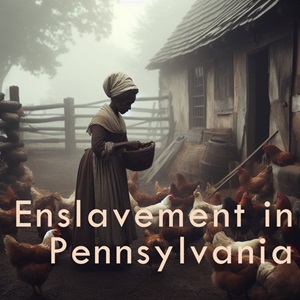
Enslavement in Pennsylvania
Methods of Resistance by Enslaved People in Pennsylvania
Types of Resistance
- Avoidance of Work
- Escape
- Escape to the British
- Violence by Slaves--Insurrection
- Violence by Slaves--Local Violence
- Fugitive Communities
Avoidance of Work
Enslaved people found many ways to express dissatisfaction with their condition. The most frequently used form of protest was to avoid work wherever possible. This tactic is not often documented but can be inferred from common descriptive terms used in advertisements concerning enslaved people. Advertisements offering slaves for sale often used such favorable terms and phrases as "active," "honest, careful and industrious," and "possesses a very obliging disposition" to describe an enslaved person who is easily managed.
Many advertisements, however, avoided the subject of the enslaved person's temperament, and stressed instead their skills and abilities. Such ads used phrases such as "understands all labour on a farm," "understands the management of a dairy, and soap boiling," and even "she understands every kind of work that belongs to a respectable family." Also mentioned frequently in ads was the enslaved person's physical condition. Able bodied slaves were described as "healthy," "stout," and "strong." While the absence of favorable terms describing a slave's temperament does not necessarily indicate recalcitrance, docility in a bound person was highly valued and slaveholders looking to sell were always eager to present their property in the most favorable terms.
A very common form of advertisement concerning enslaved persons was the escape notice, often disparagingly called a runaway ad. These differed dramatically from advertisements offering enslaved people for sale because the slaveholder did not need or want to describe the escaped person in a favorable light. In addition to describing the escapee's physical appearance and clothing, some were portrayed by their enslavers in unfavorable terms such as "artful and cunning." and is " is fond of strong liquor," which suggests another type of escapism.
Escape
A more active form of resistance often employed by enslaved people was to escape from their enslavers. Newspapers of the period from every county in Pennsylvania in which people were enslaved published notices from slaveholders seeking the return of enslaved persons who took flight. The tactic of self-emancipation was used most frequently with, and increased in proportion to, the existence of several favorable factors. Such factors included the enslaved person's familiarity with local terrain, the proximity of communities of free Blacks, and good weather. The instances of enslaved people escaping surged during the chaotic years of the American Revolution. After the war there was a brief drop in the number of enslaved people who made escape attempts, but those numbers soon rose again to new heights.
During the Revolutionary War many enslaved Blacks took advantage of the announcement from Virginia's loyalist governor Lord Dunmore promising freedom to all enslaved persons who escaped from rebel enslavers and made it to British lines. Those who lived near the port of Philadelphia, with access to ships which could take them to Virginia, and those who lived along the border with Maryland, were in the best position to take advantage of this option. Others saw an opportunity in the social upheaval caused by the war and the British occupation of Philadelphia. In Dauphin County, farmer Jacob Awl discovered in December, 1777 that his enslaved man Joe had disappeared along with one of his mares. Awl offered twenty dollars reward for the return of Joe, whom he assumed was headed toward Philadelphia where, at the time, British General Howe's army was encamped.
Daniel Larrew of Middletown, Bucks County, advertised for the return of the escaped woman Jude, who had run away in January, 1778. Larrew suspected that she was with the British because "she was frequently seen in Philadelphia while the British troops lay there, and it is supposed she is lurking in this State, or in the Jerseys, yet." James Morgan of Durham, Bucks County, registered seven enslaved people in 1780, six of them in absentia, with the notation "supposed to be in New York with the Enemy."
Violence by Slaves
Insurrection
Of all forms of resistance exhibited by enslaved people, whites feared violence the most. Slave insurrection was the subject of numerous articles appearing in The Pennsylvania Gazette, which printed reports from visitors who had just returned from places that were experiencing a violent rebellion by it's enslaved population. An example is this 1762 letter sent to one of the Gazette's correspondents in New York:
NEW YORK, December 21.
Extract of a Letter from Bermuda, dated November 30.
"I have wrote you so much, and so often, of our Negroe Plot, that you will be tired of it; yet I cannot help adding, that Juan, at Prudden, was executed last Week, and died in the most hardened Manner; telling Captain Jennings, that, had he thought he would have been there then, he would have taken Care to have prevented it; --- with much other menacing Language. Since his Death, his Son Davy, at Capt. Jennings, has made a Confession, by which it appears great Numbers were concerned, as well Women as Men. Peter Parker, who we looked upon as one of the most orderly Fellows we had, is very deeply concerned, and one of the first Promoters; he was found guilty, with five others, last Week, but Sentence was not then passed on them. Several others are taken up, and new Discoveries continually making; so that God knows when or how it will end: And I am now of Opinion, that it was known to most of the Negroes on the Island. The People are quite fatigued with keeping continual Guards and Watches. --- Peter Parker, it seems, had fixed on my House for his Habitation, and several others had made their Choice. Judge Tucker, and myself, I am told, were the first intended to be massacred in those Parts, and our Stores broke open to procure Powder, Fire arms, &c. but, Thanks to God, they have been timely prevented --- and I think it a most providential Deliverance!" (The Pennsylvania Gazette, January 07, 1762)
Although this "Negroe Plot" in Bermuda was discovered and the conspirators hanged, most Pennsylvania slaveholders must have experienced considerable disquiet in reading how the writer's trusted slave, one Peter Parker, who previously was considered above suspicion, had intended to kill his enslaver and then live in his house.
Other accounts of slave uprisings appeared regularly, some nearer, and some bloodier. It was the vivid accounts of the 1791 Haitian Slave Revolt, however, that received an inordinate amount of attention. The horror and fascination expressed by Pennsylvanians in the violence was partially because the revolt was not immediately quelled, as previous uprisings had been, and numerous slaveowners died at the hands of their former property, and partially because hundreds of white and free Black refugees fled the island's violence and came to Philadelphia, usually bringing their enslaved people with them..
From the Boston Gazette, September 26.
Extract of a letter from a gentleman at Cape Francois, to another in this town.
"On the 23d August the Negro slaves erected the standard of revolt in the country, and have destroyed all the plantations between Port Margot and Limonade - massacred the whites - plundered and burnt every thing. The distance of country now laid waste and in ashes, is sixty miles in length, and eighteen miles wide. The 26th* - the negroes are continuing their ravages - every precaution is taken to secure the city - as many sailors as could be spared from the shipping, are on shore doing duty - All the slaves in the city are confined in the church, &c."
* The day this vessel left the Cape.Extract of a letter from Cape Francois, Sep. 7.
"Since my last I have not been able to leave the army for a moment, which is actually employed against the negroe insurgents. They have massacred a great number of the whites, and have taken prisoners from females of that complexion, whom they force to do the duty of servants - They have burned more than 200 sugar plantations. I was compelled to escape by flight, and could save nothing. - My wardrobe, my furniture and plate are all in their possession. We have had several engagements with them, but without any decisive success. Our commanding officer was killed by my side, as well as several officers, who were planters in the district. I hope we shall be more fortunate in our next attack. M. de Rouyray, whom you were acquainted with, is commander in chief. The time is pressing, and I cannot give you a more particular detail at present."Translation of a Letter from CAPE FRANCOIS, dated September 11.
Since our last of the 22d ult. the fact of things is quite changed here by an insurrection of the slaves, which broke out on the 23d, in this quarter, from Port Margot to Limonade, being an extent of twenty leagues. They set fire to all the houses, and butchered all the white people they found in them. Having rendered themselves masters of all the open country, they separated into bodies of three or four hundred each, posting themselves in different houses, which serve them as places of refuge. The small number of troops we have to occupy several advantageous posts, which defend the city, does not allow us to do more than sally out against them from time to time, when they approach too near. If we had a greater number of regular troops, we might invade them in their lurking places. These ravagers are too numerous to be attacked; as they have obliged all the house-slaves, even against their will, to join them, and massacred such as attempted to make their escape. After having ravaged all the level, populous country, they made their way through many exterior settlements, and there the unfortunate few soon fell victims to their rage. They set fire to every thing on their way.We have sent to the United States, to request the assistance of some troops to assist us in destroying these ravagers. But are we to expect them? We have sent also to Jamaica, and to the Spaniards. We wait with impatience for the return of our messengers, and earnestly hope they may bring us satisfactory answers. Our only security is this city, which is fortified and well guarded. At the commencement of these disturbances, our chief apprehensions were from our domestic slaves, who were in great numbers, and might perhaps be in league with the insurgents, to set fire to our houses. But our vigilance, by day and by night, has preserved us from their suspected designs. Several have however, been seized, and brought to justice. The others, who were not suspected, have nevertheless been put in a place of security. By means of this prudent precaution, we now enjoy greater tranquillity. (The Pennsylvania Gazette, October 05, 1791)
Local Violence
Pennsylvania slaveholders could take little comfort in the fact that the slave uprisings that they read about were in such exotic locations such as Bermuda and Haiti. Although far short of insurgency, there were notorious incidents of local enslaved people taking violent action against their enslavers, or against the white population at large. One such case was tried in the courts of Cumberland County at Carlisle in 1801. An enslaved teenage girl, Chloe, was charged with murdering two children in her charge. After a fight with her owner, Mary Carothers, Chloe drowned one of the children in a nearby stream and otherwise killed a second child. She threatened to do the same to the third child, but was prevented. Chloe was found guilty of first degree murder and publicly hanged in Carlisle.
Similarly, in 1803 a York County enslaved woman was indicted for poisoning the white family that owned her. Shortly after she was imprisoned, numerous mysterious fires plagued York, and local authorities suspected that a concerted effort was underway by local Blacks who were setting the fires in protest. The fires became so troublesome that the borough required all free Blacks to carry a pass to enter the town. Enslaved people, presumably, would already have a pass to be away from their enslavers.
Fugitive Communities
Groups of escaped slaves who sheltered in remote regions in camps or makeshift settlements were a constant concern for county authorities and local slaveholders. Chester County slaveholder James Sharps advertised in 1779 for his escaped man Abel, who he suspected would make his way toward a cedar swamp in Delaware which harbored a community of free Blacks. Abel had apparently secured a bogus pass from a co-conspirator.
The vast tracts of forested land that surrounded iron forges, a necessary requirement to keep them supplied in charcoal, were hospitible environments for the self-emancipated. Two such men took to banditry near Peter Grubb's Cornwall Furnace in what is now Lebanon County:
TWENTY POUNDS Reward.
THE subscriber was attacked, on Saturday, the 12th day of May, 1787, in the morning, on Curtis Grub's Hills, on the road to Lancaster, by two Black coloured Villains, one an elderly man with a ragged coat, about 5 feet 6 inches high, the other a young man, short and fat. One with a gun shot the subscriber's mare under him dead. They robbed him of the following sums of public money, viz, 29 £ specie, 270 £ paper money of the last emission, and 161 £ of the emission of 1781, 100 £ whereof are in 5 £ bills and two whole sheets. Whoever shall apprehend the said villains, and secure them in any gaol, that they may be punished, shall have the above reward, or TEN POUNDS for any of them, and reasonable charges, by BENJAMIN MOORE, Collector of Lebanon township, Dauphin county.
May 14, 1787. (The Pennsylvania Gazette, May 23, 1787)