 slavery
to
freedom

Study Areas:
December 1766: Lucy Escapes from Sint Eustatius in a Schooner
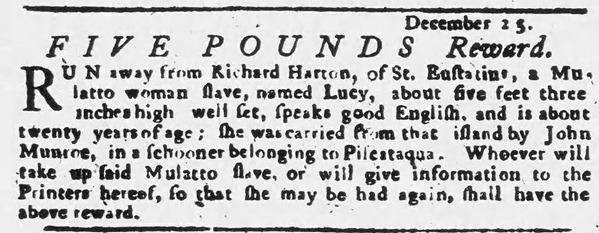
December 25.
FIVE POUNDS Reward.
RUN away from Richard Harton, of St. Eustatius, a Mulatto woman slave, named Lucy, about five feet three inches high well set, speaks good English, and is about twenty years of age; she was carried from that island by John Munroe, in a schooner belonging to Piseataqua. Whoever will take up said Mulatto slave, or will give information to the Printers hereof, so that she may be had again, shall have the above reward.
Source: The Pennsylvania Journal or Weekly Advertiser, 25 December 1766.
Notes: Advertisements in Pennsylvania newspapers for the recapture of enslaved people who escaped from a Caribben island are rare. This ad, in the Philadelphia newspaper The Pennsylvania Journal, instructs anyone with information to give it to the printer of the paper, Philadelphia resident William Bradford.
John Munroe was a ship's captain who frequented eastern seaboard ports. His name appears in a Philadelphia newspaper in 1763 as master of the Brig Friendship, listed as outward bound for North Carolina. (The Pennsylvania Journal or Weekly Advertiser, 24 March 1763). Richard Harton, the enslaver of Lucy, must have had reason to believe the Munroe and Lucy would sail for Philadelphia after her December 1766 escape.
Sint Eustatius, also called Statia, was controlled by the Dutch and was an important trading island in the Caribbean because it maintained a neutral status, allowing free trade with all the European powers. It would later play an important role in supplying the American colonies during the American Revolution.
 Covering the history of African Americans in central Pennsylvania from the colonial era through the Civil War.
Support the Afrolumens Project. Buy the books:
The Year of Jubilee, Volume One: Men of God, Volume Two: Men of Muscle