 Slavery
to
freedom


Study Areas
1803 Ordinance Restricts Enslaved Blacks from Entering York
In March 1803 the Burgesses of the borough of York, Pennsylvania passed an ordinance forbidding all enslaved Blacks from entering the borough during daylight hours without a pass detailing the exact nature of their business and with whom they were visiting. Furthermore, they had to leave town "at least one hour before sun down, on pain of being imprisoned or at the risk of their lives."
Free Blacks living in the borough were required to secure a pass from either of the borough's Justices of the Peace in order to go about their daily business. They were subject to being challenged by white residents at any time. This intimidation tactic was designed to keep them in their homes and off the streets most of the time.
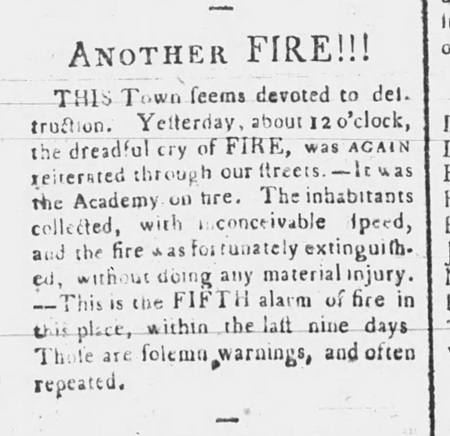 This highly restrictive ordinance resulted from suspicions that local Blacks were resonsible for a series of highly destructive fires that plagued the borough in February and March. The first occurred at 4 am on Monday, February 28, completely destroying the stable of Richard Koch. Over the next nine days no less than five fires had shaken the town's populace.
On Monday, March 16, a fire began in the barn of a Mr. Sinn and within minutes had spread to the barns of four other prominent farmers, completely destroying the buildings along with their valuable hay and straw stores. The York Recorder reported "The inhabitants are worn out with watching and fatigue, and sickening under apprehensions of greater calamities." A two-hundred dollar reward was offered for apprehension of those responsible.
At some point, suspicion fell upon the borough's Black population, and on those enslaved Blacks in the surrounding countryside. In May of the previous year, the York Recorder had carried the story of a plot by enslaved Blacks to burn the town of Norfolk, Virginia. York's white population suspected the same plot was at work in their town. They convinced Pennsylvania Governor Thomas McKean of their beliefs, and he issued an official proclamation, without citing proof, that publicly indicted local Blacks of their complicity:
A Proclamation.
With the blessing of Governor McKean, York's Burgesses and Justices of the Peace drew up the ordinance that would bar enslaved Blacks from the countryside from entering town and keep local free Blacks suppressed for as long as they deemed necessary.
Whereas it has been represented to me by a number of the inhabitants of the Borough of York, that eleven or more buildings within the same have been lately consumed by fire; that a most wicked and daring conspiracy appears to have been formed for the purpose of burning the said Borough; and that from a variety of circumstances, it is believed, a number of Negroes or black persons, within said Borough and its vicinity, have combined together, to carry into effect so nefarious a design.
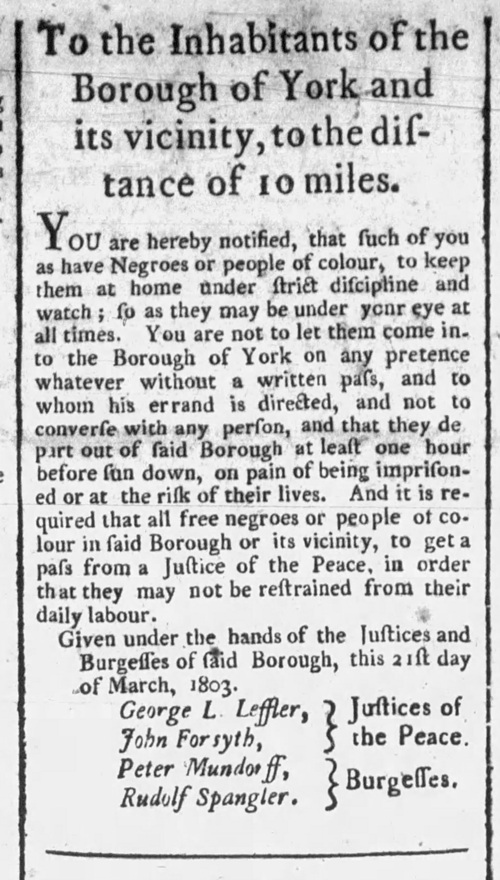
To the Inhabitants of the Borough of York and its vicinity, to the distance of 10 miles.
Published in the Pennsylvania Republican newspaper
To the Inhabitants of the Borough of York and its vicinity, to the distance of 10 miles.
You are hereby notified, that such of you as have Negroes or people of colour, to keep them at home under strict discipline and watch; so as they may be under your eye at all times. You are not to let them come into the Borough of York on any pretence whatever without a written pass, and to whom this errand is directed, and not to converse with any person, and that they depart out of said Borough at least one hour before sun down, on pain of being imprisoned or at the risk of their lives. And it is required of all free negroes or people of colour in said Borough or its vicinity, to get a pass from a Justice of the Peace, in order that they may not be restrained from their daily labour.
Given under the hands of the Justices and Burgesses of said Borough, this 21st day of March, 1803.
George L. Leffler, John Forsyth, } Justices of the Peace.
Peter Mundorff, Rudolf Spangler. } Burgesses.
Sources
York Recorder, 26 May 1802, 02, 09, 16 March, 20 April 1803.
Harrisburg's 1821 registry of free Black residents was located several years ago in the city archives. Read about it here.
A complete transcription of names and page images from that original registry is available on this site.
Lancaster's "Negro Entry Book" is examined and detailed in the article "The Negro Entry Book: A Document of Lancaster County's Antebellum African American Community," by Leroy T. Hopkins, Jr., published in the Journal of the Lancaster County Historical Society.