 slavery
to
freedom


A series of pages exploring
various aspects of enslavement in Pennsylvania
Race, Bondage, Women and Children
Enslaved Caesar and His White Wife Escape, 1782
Escape from Jacob Weaver in Amity Township, Berks County, Pennsylvania
News item from The Pennsylvania Gazette, Philadelphia, 19 June 1782
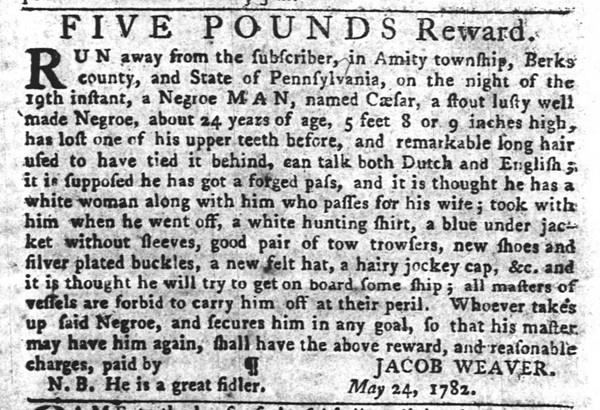
FIVE POUNDS Reward.
RUN away from the subscriber, in Amity township, Berks county, and State of Pennsylvania, on the night of the 19th instant, a Negroe MAN, named Caesar, a stout lusty well made Negroe, about 24 years of age, 5 feet 8 or 9 inches high, has lost one of his upper teeth before, and remarkable long hair, used to have tied it behind, can talk both Dutch and English; it is supposed he has got a forged pass, and it is thought he has a white woman along with him who passes for his wife; took with him when he went off, a white hunting shirt, a blue under jacket without sleeves, good pair of tow trowsers, new shoes and silver plated buckles, a new felt hat, a hairy jocky cap, &c. and it is thought he will try to get on board some ship; all masters of vessels are forbid to carry him off at their peril. Whoever takes up said Negroe, and secures him in any goal, so that his master may have him again, shall have the above reward, and reasonable charges, paid by
JACOB WEAVER.
N.B. He is a great fidler. May 24, 1782.
Notes: The advertisement above focuses almost solely on the escaped enslaved man Caesar, noting his age, physical description,, dress and habits. The only mention of the woman in this advertisement is the phrase "it is thought he has a white woman along with him who passes for his wife." The enslaver, Jacob Weaver, an innkeeper and farmer in Berks County, has no interest in the woman's role in the escape or her relationship with Caesar beyond the possibility that including a mention of her in the escape advertisement might add a clue if the pair are seen together. Weaver's only goal is to recover his escaped enslaved man.
No name, description or age is provided for the woman beyond her race. Yet Weaver must have had at least some knowledge of her, as he could say that she "passes for [Caesar's] wife." From his phrasing, it is evident that Weaver assigns no legitimacy to the marriage, and it is highly unlikely the pair were joined in a ceremony in any local church. Yet the fact that the woman joined Caesar on a dangerous escape is a clue that their relationship was more than casual.
The fate of Jacob and his wife and their future is placed under a shadow by Weaver's expectation that Jacob will attempt to ship out to sea, either from Philadelphia or another port city. His wife would be unable to join him on a ship and would therefore have to find shelter and a means of making a living in that port city, which was possible as such large ports typically held opportunities for work, albeit with meager wages and barely tolerable working conditions.
Source: The Pennsylvania Gazette, 19 June 1782.