 slavery
to
freedom


A series of pages exploring
various aspects of enslavement in Pennsylvania
Maritime Items Related to Slavery in Pennsylvania
Sale of the Privateer Marlborough
July 14, 1746
Notice of Public Sale
The notice below announces the public auction for the privateer ship Marlborough, in July 1746. In addition to the sale of the ship itself, it notes that all stores and weapons were to be auctioned on the same day. Three enslaved men were also listed as part of the ship's complement to be sold. Note that there were two other privateers named Marlborough, both from Rhode Island, one of which achieved fame for its actions during the Revolutionary War. This news item is about the Privateer Marlborough of Philadelphia, which was active in 1745 and 1746.
Philadelphia, June 25th. 1746.
Source: The Pennsylvania Journal or Weekly Advertiser, 26 June 1746.
THis is to give Notice that on Monday the 14th of July next at 10 o'Clock in the Morning, will be sold, as a Merchant Ship, by Publick Vendue at Oswald Peel's Wharff, The Privateer Ship Marlborough, One Year and an half Old, Burthen 221 Tons, with all her Tackle and Furniture: An Inventory of which is to be seen at Peter Bard's.
One the same Day will be sold her Guns, Small Arm's, Pistols, Cutlasses, Powder, and all other Stores belonging to her, fitting for a Privateer, and also three fine Negro Slaves.
Notes on Black free and enslaved men on privateers: The advertisement for the sale of the Marlborough included "three fine Negro Slaves," as part of its inventory of items to be auctioned off. These men were owned by the ship's investors and although they helped man the ship, were not officially considered members of its crew, but rather were considered part of its "stores" that included the weapons, ammunition, and other supplies.
Free Blacks could and did sign on as crew members of privateers, an opportunity that escaped slaves apparently exploited as a way of eluding capture, judging from the frequency of warnings in escaped slave notices to captains of vessels not to take freedom seekers on board. The following advertisement from Trenton, New Jersey slaveholder Thomas Cadwalader refers to this plan specifically:
RUN away on Saturday the 26th of October, from Thomas Cadwalader, of Trenton, a Negro Man, named Sam, a likley Fellow, about 26 Years of Age, speaks very good English: Had on when he went away, a good Duroy Coat, a fine Hat, almost new, a Pair of good Leather Breeches with Trowsers over them; but as he has other Clothes with him, he may have changed them since. He was enticed away by one Isaac Randall, an Apprentice of Thomas Marriot, jun. They took with them a likley bay Gelding, six Years old, thirteen Hands and a Half high, paces well, and is shod before: And they are supposed to have gone with a Design to enter on board a Privateer, either at New-York or Philadelphia. Whoever takes them up, and secures the Negro and Gelding, shall be wll rewarded, by THOMAS CADWALADER. (The Pennsylvania Gazette, 31 October 1745.)There is no way to know how many of the Black crewmembers of privateers were actually escaped slaves. The Marlborough advertised for crew members for many weeks prior to sailing and then had seven who skipped out with their bounty money. It is likely that few questions were asked of potential crew members upon signing. When a possible permissiveness as to a man's history was coupled with the opportunity to hide at sea on a voyage of several months while also earning money, it is therefore likely that some escaped slaves successfully hid from slaveholders by posing as free crewmembers on a vessel.
Notes on the Marlborough:
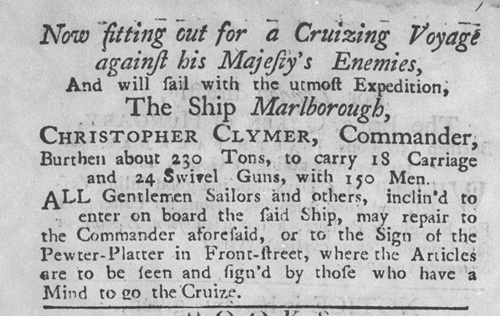
The ship Marlborough was launched from the shipyard in Burlington, New Jersey, in 1744:
The site of that old ship yard is known, historically, as Barbarroux wharf. From its ways, in 1744, when George the Second was at war with both France and Spain, the privateer Marlborough was launched. The capabilities of that early ship yard may be estimated by the fact that the full complement of the Marlborough's crew was one hundred and fifty men. (William E. Schermerhorn, The History of Burlington, New Jersey, 1927, page 304.)Philadelphia Merchant Peter Bard, listed in the sale notice above as holding the inventory list of the Marlborough, was one of the owners and investors of the ship as a privateer. The ship first appears in February 1745 in a published announcement of her readiness for action:
Sunday last the Privateer Ship Marlborough, Christopher Clymer Commander, of 18 Carriage Guns, 24 Swivels, and 150 Men, fell down, in order to proceed on a Cruize against his Majesty's Enemies. (The Pennsylvania Gazette, 19 February 1745.)There were immediate problems. A man who had signed on with the crew skipped out with his signing bounty before she sailed. Bard advertised for his capture:
WHEREAS, Charles Wells received Six Pounds advance Money from the Owners of the Privateer Ship Marlborough, and has not been since seen. He is aged 45 Years, of middle Stature and thin Visage, and had on a brown Coat. Whoever secures the said Wells, shall have 20 s. Reward, and reasonable Charges paid by PETER BARD. (The Pennsylvania Journal, or, Weekly Advertiser, 12 March 1745.)The Marlborough's first cruise began with great expectations and an initial potential prize. A month later it brought in a disappointingly small prize:
Yesterday arrived here the Snow Hope, Andrew Andrews, sent in by the Privateer Ship, Marlborough, Christopher Clymer, Commander, and is said to have been bound from Eustatia to Amsterdam, but is suspected to have French Goods on board. It is not yet known whether she will prove a Prize or not. We hear that the Marlborough had Intelligence of two rich French Ships, and great Hopes of intercepting them. (The Pennsylvania Gazette, 09 May 1745.)Upon returning to Philadelphia in early September 1745 the Marlborough had little to show for it's initial cruise and investment.
PHILADELPHIA.
Last Friday arrived here Capt. Darrel from Barbados, who informs us, that two 60 Gun Ships were arrived there from England, and had sailed again for Antigua. That Capt. Clymer, in the Privateer Marlborough, had been there, and brought in with him a small Tender to a French Guineaman. Capt. Clymer also spoke with two large Men of War and a Fleet of Merchantmen bound to Antigua; upon whose arrival, it is hop'd, Commodore Knowles will come out of English Harbour and look the French in the Face. (The Pennsylvania Journal, or, Weekly Advertiser, 20 June 1745.
Tuesday last arrived here the Privateer Ship Marlborough, of this Place, Christopher Clymer Commander, from a Cruize, in which he brought to near 70 Sail, but they all proved Friends; so that tho' he has made an industrious Cruize, it has not proved a successful One. Capt. Clymer, in Lat. 33. spoke with Capt. Brame for this Place, and Capt. Stedman for Virginia, in Company with the Virginia Convoy. (The Pennsylvania Gazette, 19 September 1745.)It prepared to sail again, advertising for crewmembers:
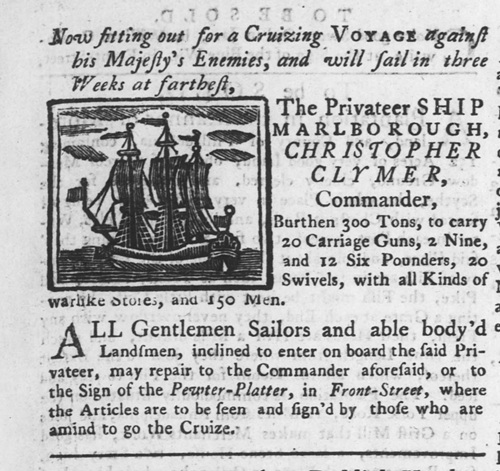
Bard and his fellow owners again experienced bad faith crew signings. This time seven men absconded in early December, just prior to the ship's sailing, with 4 pounds bounty money and 4 pounds advance wages. Despite the loss of crew, the Marlborough sailed that December and by February its investors received a hopeful letter:
PHILADELPHIA,Captain Clymer's prediction that the French ship was "very rich" proved accurate. In April the following report was made. In addition to the cheese that Clymer sent to Jamaica, he brought in a substantial store of French goods destined for Cape Francois. As a bonus, the Marlborough "retook" another un-named schooner from a Spanish privateer and shot up the Spanish ship, driving it ashore in Puerto Rico.
Copy of a Letter to the Owners of the Privateer Ship Marlborough, belonging to this Port, dated, Kingston, Jamaica, February the 27th, 1745,6.
We received Saturday last a Letter from Captain Christopher Clymer, wherein he informs us that he had taken a Ship from Marseles just as she was going into Cape Fransway, wherein he found a small quantify of Cheese, which he sent down to us, judging they would sell better here than in Philadelphia, which we have received and shall dispose of them as soon as possible; he mentions that the Ship was very rich but could not say the amount. (The American Weekly Mercury, 27 March 1746.)
PHILADELPHIA.The second voyage of the Marlborough was a success, and Bard and his fellow investors made the decision to liquidate their investment, selling the privateer as an ordinary merchant vessel and auctioning off its stores, supplies and enslaved men.
Yesterday arrived here a French Prize Ship taken by Capt. Christopher Clymer in the Privateer Ship Marlborough, which he took the 14th of February, seven Leagues off of Monte Christo on Hispaniola, commanded by Jean Baptiste Troopez Martin, bound from Marseiles to Cape Francois, mounting 10 Carriage Guns and 36 Men, having on board, 250 Hogsheads of Wine, 200 Anchors of Brandy. 400 Cases of Oil. 500 Ditto of best Cordials. 50 Cases of Anchovies. 100 Cases of Olives. 30 Trunks of Shoes. 20 Cases of Hatts, 4 Cases of Drabs. 10 Cases of Calico. 5 Cases of Fruit in Brandy. 400 Cases of Figs and Raisons. 100 Cases of Fontenac. 100 Ditto of Capers. 12 Casks of Ammons. 150 Barrels of Flour. 6 Barrels of Cheese. 250 Cases of Soap. 200 Ditto of Candles. 30 Ditto Wax Candles. 150 Sugar Pots. 13,000 Bricks. 10 Cases of Delph Ware. 20 Barrels of Gun Powder. 5 Chests of Paper. 6 Bales of Dry goods. 50 Chests of Bacon. 1 Chest of Peruke Powder. Sundry Medicines. Ships Muskets. Sundry Boxes of Velvets and Silks. 5 Doz. Marble Mortars. 500 weight of Brimstone. Several Trunks of Men and Womens Stockings. A Quantity of Gold Lace. Several Marble Tables, &c.
Capt. Clymer, before he took this Prize, retook a Schooner in Sight of Antigua from Marblehead, and sent her into St. Christophers; and drove ashore on the South West Part of Porto Rico a Spanish Privateer mounting 12 Carriage Guns, he fired 63 Shot at her, and hull'd her several Times, and was in great Hopes she would never get off again. (The Pennsylvania Journal, or, Weekly Advertiser, 03 April 1746.